
Scope
Does the fee cover investment management only, or also taxes, retirement, cash flow, insurance, estate coordination, and ongoing decisions?

Free advisor fee calculator
See the dollar difference between a flat annualized financial planning fee and a percentage-of-assets fee using your own numbers.
Direct answer
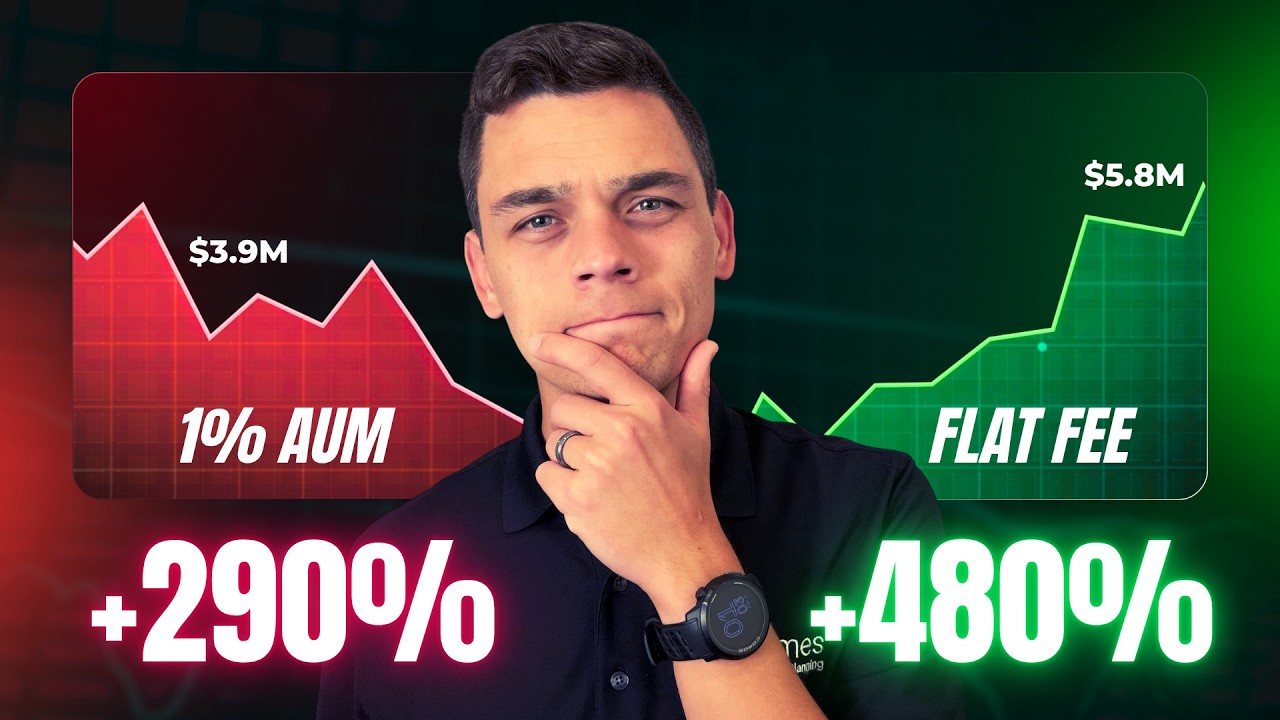
A flat fee stays fixed unless the scope or price changes. An AUM fee is calculated as a percentage of managed investments, so the dollar cost generally rises as the portfolio grows. At a 1% rate, a $1 million portfolio starts with an estimated $10,000 annual advisory fee, compared with the $6,600 annualized Flames Premier fee in the default example.
Interactive calculator
Adjust the portfolio, AUM rate, assumed growth, flat annualized fee, and comparison period. Results update instantly. Use Copy scenario link when you want to share your assumptions; the browser address stays clean.
Your assumptions
Adjust the values to model your scenario.
Estimated impact
Updates liveCumulative fee comparison
Assumptions and limitations: This is a simplified educational illustration, not a performance forecast. It applies the selected AUM rate to each year's beginning portfolio balance, grows that balance at the selected rate for the next year, and holds the flat annualized fee constant. Both fees are treated as paid separately and do not reduce the modeled portfolio balance. It excludes withdrawals, deposits, taxes, fund expenses, trading costs, service differences, and future price changes.
Read the result
Compare the cost in dollars, then compare what each relationship actually includes.
Does the fee cover investment management only, or also taxes, retirement, cash flow, insurance, estate coordination, and ongoing decisions?
Ask whether the advisor earns more when you roll over assets, keep money under management, or avoid paying down debt.
Compare advisor access, planning updates, tax-return preparation, implementation support, custody, and who will answer when life changes.
Example
A 1% fee equals $2,500 per year on $250,000, $5,000 on $500,000, $10,000 on $1 million, and $20,000 on $2 million before considering portfolio growth or compounding. Translating the percentage into dollars makes the comparison easier to evaluate.
A 1% AUM fee is approximately $5,000 per year if the portfolio stays at $500,000.
A 1% AUM fee is approximately $10,000 per year if the portfolio stays at $1 million.
A 1% AUM fee is approximately $20,000 per year if the portfolio stays at $2 million.
Watch and learn
Start with three videos selected for this page, then use the controls to explore every published Flames FP video guide.
Videos 1–3 of 14











Common questions
An AUM fee is an advisory fee based on assets under management. A 1% annual rate on $1 million is approximately $10,000, although billing methods and breakpoints vary by firm.
No. The answer depends on the flat fee, the AUM rate, portfolio size, included services, and how long the relationship lasts. Cost should be compared alongside scope and value.
Yes. It uses the annual growth rate you select to illustrate how the AUM fee can change as the portfolio changes. The result is educational and not a performance forecast.
No. Flames FP uses flat quarterly memberships of $900 or $1,650 based on service scope, not a percentage of the investment portfolio.
Compare the complete relationship
Compare Flames Planning and Premier at $900 or $1,650 per quarter, then choose the relationship that matches the help you need.