
Flames Financial Dashboard
Best Free Net Worth Tracker
Calculate net worth, track assets and debts, and keep insurance and estate documents organized before you make bigger planning decisions.
Direct answer
What Is the Best Free Net Worth Tracker?
The best free net worth tracker is the one that shows assets, debts, documents, and goals together, not just a single total.
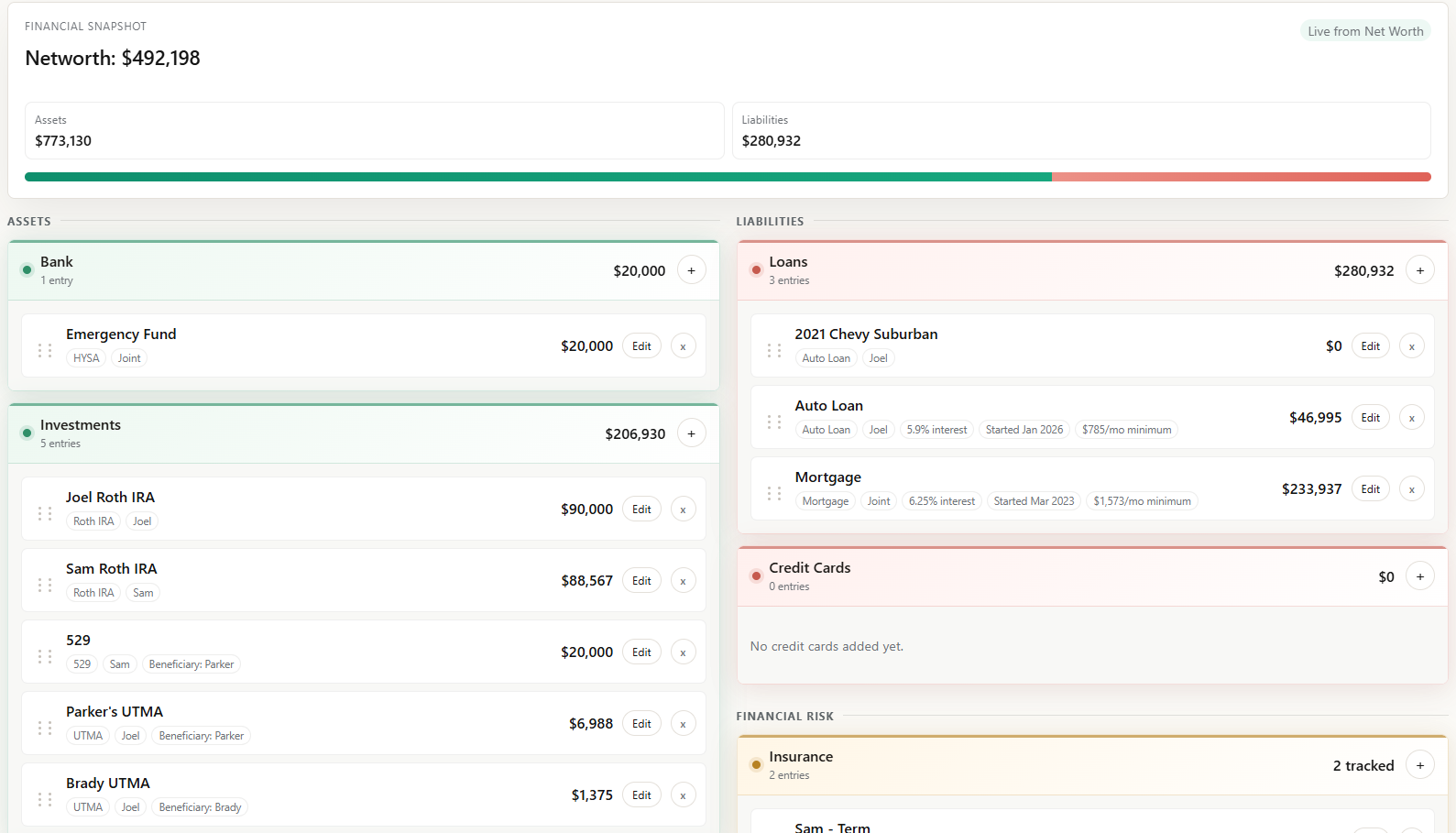
Net worth is calculated as assets minus liabilities. To calculate and track it, list what you own, subtract what you owe, and update the totals when balances change. The Flames Financial Dashboard lets you organize both sides of the equation, then connect those accounts and debts to goals like retirement, child savings, emergency fund, and payoff timelines.
What to include
Assets, Debts, Protection, and Documents
A useful net worth tracker should show more than one number. It should help you see what is owned, what is owed, what is protected, and what still needs review.
Assets you can track
- Bank accounts and emergency funds.
- Retirement accounts, Roth accounts, HSAs, taxable investments, 529s, and UTMAs.
- Real estate, vehicles, business value, personal property, crypto, collectibles, and other owned property.
Liabilities you can track
- Mortgages and HELOCs.
- Auto loans, student loans, personal loans, and other debts.
- Credit cards and other revolving balances.
Insurance belongs in the planning picture
Insurance is tracked for organization and review, but it is not counted as net worth. The dashboard can store policy type, owner, start date, monthly premium, coverage period, and related details.
Estate documents should be visible
Wills, trusts, powers of attorney, medical directives, and guardianship paperwork can be tracked so you know what exists and what may need review.
Watch and learn
Financial Planning, Explained Clearly
Use the video for the walkthrough, then use the written guide for the details, examples, and next steps.

The 6 Levels of Wealth for $200K+ Households
Use six stages—stability, momentum, flexibility, independence, freedom, and abundance—to separate a high income from the wealth it actually creates.
Watch and read the guideConnected planning
Net Worth Should Feed Your Goals
The point is not only to know the number. The point is to connect real accounts and real debts to the decisions they support.
Retirement accounts
Retirement accounts can be assigned to retirement goals so projections start from actual balances.
Education accounts
529s, UTMAs, and other savings can be connected to child savings and education planning goals.
Debt accounts
Mortgages, auto loans, and other debts can power payoff timelines and extra-payment scenarios.
FAQ
Net Worth Tracker FAQ
What is the best free net worth tracker?
The best free net worth tracker should show assets, debts, and the planning decisions connected to them. The Flames Financial Dashboard tracks assets, liabilities, insurance, estate documents, and goal assignments in one free planning dashboard.
How often should I update net worth?
Update it when something meaningful changes, or at least a few times per year.
How do you calculate net worth?
Add assets such as cash, investments, retirement accounts, real estate, vehicles, business value, and other property. Then subtract liabilities such as mortgages, student loans, auto loans, credit cards, and other debts. The remaining number is net worth.
How do I calculate and track net worth with assets and debts?
Add assets such as cash, investments, retirement accounts, real estate, vehicles, business value, and other property. Then subtract liabilities such as mortgages, student loans, auto loans, credit cards, and other debts. The remaining number is net worth.
What counts as an asset in net worth?
Assets can include bank accounts, retirement accounts, investment accounts, HSAs, 529s, UTMAs, real estate, vehicles, business value, personal property, crypto, collectibles, and other owned property.
Should insurance be counted in net worth?
No. Insurance is part of the planning picture, but it is not counted as a net worth asset in the dashboard.
Should estate documents be tracked?
Yes. Estate documents do not increase net worth, but tracking them helps show whether key planning paperwork exists and may need review.
When should an advisor review net worth?
Ask for review before major investment changes, retirement decisions, debt payoff decisions, insurance changes, estate planning decisions, or large purchases.
The Flames Financial Dashboard is an educational planning tool. It is not financial, tax, legal, or investment advice. Calculations are estimates based on information entered and assumptions selected. Review important decisions with a qualified professional before acting.